
Creating a reliable commercial kitchen equipment list is one of the most important steps when opening or redesigning a professional kitchen. Equipment choices influence workflow, food quality, staffing efficiency and long-term operating costs.
Whether launching a restaurant, catering unit or central production kitchen, defining a basic commercial kitchen equipment list requires balancing current needs with future scalability. The objective is not simply to purchase appliances, but to build a coherent production system.
How to scope your kitchen and service model
Before drafting a commercial kitchen equipment list, clarify the service model.
Key questions include:
- What is the expected number of covers per service?
- Is the operation à la carte, batch production or delivery-focused?
- What menu complexity is planned?
- How many staff members will operate simultaneously?
Understanding these variables determines the size, type and number of appliances required.
Operators often focus on individual pieces of commercial kitchen equipment without mapping production flow. Instead, the equipment line-up should follow the sequence of storage, preparation, cooking, holding and washing.
Planning at this stage prevents overspecification and reduces future retrofit costs.
Core cooking equipment
Cooking appliances form the backbone of any professional kitchen. The selection depends on menu type, service rhythm and output expectations.
Ranges, ovens and grills
A typical basic commercial kitchen equipment list includes:
- Cooking ranges (gas or induction)
- Convection or combi ovens
- Grills or griddles
Ranges provide flexibility for multiple pans and simultaneous preparation. Ovens support roasting, baking and regeneration. Grills and griddles are essential in high-turnover service environments.
Choosing the best commercial kitchen equipment in this category means evaluating heat recovery speed, energy efficiency and durability under peak load.
Fryers and specialist heat
For menus including fried or high-temperature items, dedicated fryers are essential.
Specialist heat equipment may include:
- Pasta cookers
- Bratt pans
- Chargrills
- Salamanders
The goal is to match equipment capability with menu demand. Overloading multi-purpose equipment often reduces output consistency and slows service.
Refrigeration and cold prep
Cold storage is as critical as cooking capacity.
A comprehensive commercial kitchen equipment list must account for:
- Upright refrigerators and freezers
- Undercounter refrigerated units
- Prep counters with integrated cold storage
Temperature stability and rapid recovery after door openings are fundamental in high-traffic kitchens.
Storage, blast chilling and GN sizes
Blast chillers are increasingly part of the best commercial kitchen equipment configurations, especially in operations using cook-and-chill systems.
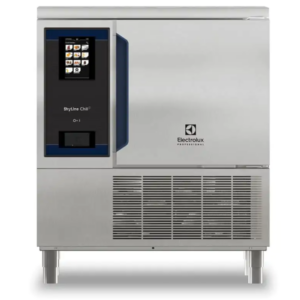
GN (Gastronorm) sizing compatibility should be standardised across ovens, refrigeration and holding units. This ensures a smoother workflow and reduces the need for transfer containers.
Structured cold prep areas improve food safety compliance and minimise cross-contamination risk.
Warewashing
Warewashing is frequently underestimated during planning.
A complete basic commercial kitchen equipment list should include:
- Undercounter or hood-type dishwashers
- Pre-wash tables
- Clean and dirty rack storage
- Water treatment systems where required
Throughput must match peak service volume. Undersized warewashing systems create bottlenecks that disrupt the entire operation.
Selecting from the best commercial kitchen equipment brands means evaluating not only wash performance but also water efficiency, reliability and service support.
Optional add-ons and future upgrades
Once the core line-up is defined, operators can assess optional additions.
Examples include:
- Heated holding cabinets
- Vacuum packing equipment
- Smart monitoring and connectivity tools
- Energy recovery systems
Future-proofing the kitchen allows scaling production without major redesign.
Building the right commercial kitchen equipment foundation from day one protects operational continuity and long-term profitability. Explore Electrolux Professional commercial kitchen solutions designed to support scalable, efficient and performance-driven commercial kitchens, and request expert guidance for your project.
Checklist
Before finalising your commercial kitchen equipment list, confirm:
- Equipment aligns with projected service volume
- Utilities (gas, electricity, water) support installed load
- Workflow follows logical production sequencing
- GN sizes are standardised
- Warewashing capacity matches peak demand
- Maintenance access is adequate
- Future expansion has been considered
A structured approach ensures the kitchen performs as a system rather than as isolated appliances.