
In professional kitchens, the oven is not just another appliance. It defines production capacity, menu consistency and service timing. Selecting the best commercial oven requires more than comparing prices or dimensions. It demands alignment between cooking method, output expectations and operational rhythm.
From bakeries and restaurants to catering and institutional kitchens, the right commercial oven becomes the backbone of consistent food quality. This guide outlines how to evaluate types, capacity and features to make an informed decision.
Oven types at a glance
Different oven technologies serve different operational needs. Understanding these distinctions is essential when comparing best commercial oven brands and configurations.
Convection
Convection ovens circulate hot air using internal fans, creating even heat distribution across multiple trays.
They are commonly used for:
- Roasting meats
- Baking pastries and bread
- Regenerating prepared dishes
Convection models are typically reliable and versatile. For kitchens with straightforward menus and moderate volume, they often represent an efficient entry point into professional ovens.
Key evaluation criteria include airflow balance, temperature stability and recovery time between batches.
Combi
A commercial combi oven combines convection heat with controlled steam injection. This allows operators to adjust humidity levels during cooking.
Combi ovens support:
- Moisture retention in proteins
- Even baking with improved texture
- Multi-level cooking without flavour transfer
- Regeneration with reduced drying
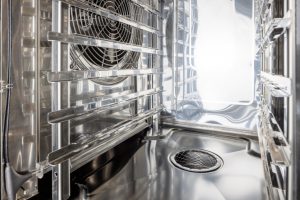
For high-volume or menu-diverse operations, combi technology offers flexibility and yield optimisation. When assessing the best commercial oven, combi systems often provide the widest range of cooking functions within a single footprint.
Matching oven types to menu and method
The oven should reflect how food is produced.
Consider:
- Is the menu protein-heavy, bakery-focused or mixed?
- Are dishes prepared à la carte or in batches?
- Is overnight cooking required?
- Are multiple trays cooked simultaneously?
A bakery-focused concept may prioritise deck or convection ovens. A hotel kitchen handling banqueting and à la carte service may benefit from a commercial combi oven system that adapts to varying humidity levels.
The best commercial oven is not necessarily the most advanced model, but the one that aligns with menu execution and service speed.
Capacity, footprint and stacking options
Capacity planning is critical. Undersized ovens create bottlenecks; oversized units increase energy consumption unnecessarily.
Key factors include:
- Number of covers during peak service
- Tray format compatibility (GN sizes)
- Available floor space
- Ceiling height for stacked configurations
Stackable professional ovens allow vertical expansion without increasing footprint. This is particularly useful in compact urban kitchens.
When comparing the best commercial oven brands, modularity and future scalability should be part of the evaluation.
Controls, programmability and connectivity
Modern commercial ovens go beyond manual temperature and timer controls.
Advanced systems may offer:
- Programmable cooking cycles
- Core temperature probes
- Multi-step cooking sequences
- Automatic humidity regulation
- Connectivity for monitoring and updates
Programmability supports consistency across shifts and sites. In multi-unit operations, digital recipe management ensures standardisation.
Connectivity also enables performance tracking and preventive maintenance planning, supporting long-term operational efficiency.
For many operators, these features define what qualifies as the best commercial oven in today’s market.
Installation, utilities and ventilation
Before purchasing a commercial oven, assess site infrastructure.
Consider:
- Electrical or gas supply capacity
- Water connection requirements (for combi models)
- Ventilation and extraction systems
- Floor load limits
Steam-generating ovens require proper drainage and water treatment systems. Ventilation must comply with local regulations and ensure a safe working environment.
Early infrastructure assessment prevents costly adjustments after delivery.
Cleaning systems and daily care
Cleaning requirements vary significantly between oven types.
Convection ovens typically require manual cleaning routines. Combi models often include automatic cleaning cycles with controlled detergent dosing.
Effective cleaning systems help:
- Maintain cooking performance
- Protect internal components
- Reduce downtime
- Support hygiene compliance
Selecting the right commercial oven shapes kitchen performance for years. By aligning oven type, capacity and control features with your menu strategy, you ensure consistent results service after service. Explore Electrolux Professional commercial kitchen solutions and request expert guidance to configure the right solution for your kitchen.
FAQs
What is the best commercial oven for a restaurant?
It depends on menu complexity and volume. Convection ovens suit straightforward production, while combi systems offer flexibility for diverse menus.
Are combi ovens better than convection ovens?
Combi ovens provide additional humidity control and versatility, but may not be necessary for every operation.
How do I size a commercial oven correctly?
Calculate peak tray output per service and align capacity with available space and utilities.