In high-performance professional kitchens, understanding what a combi oven is and how it supports daily production is essential. A commercial combi oven combines steam and convection cooking in one integrated system, giving operators precise control over temperature and humidity. From restaurants and hotels to healthcare and contract catering, this technology directly influences food quality, workflow efficiency and service consistency.
What is a combi oven?
When asking what a combi oven is, the answer is straightforward: it is a professional oven that integrates three cooking modes within a single chamber.
- Convection mode uses dry, circulated heat for roasting, baking and browning.
- Steam mode introduces controlled humidity, ideal for vegetables, fish and regeneration.
- Combination mode blends steam and dry heat to optimise texture, colour and yield.
This flexibility allows a commercial combi oven to replace several traditional appliances. Instead of operating separate convection ovens and steamers, kitchens centralise production in one controlled environment.
An Electrolux Professional combi oven like SkyLine is engineered to manage airflow, temperature stability and humidity with precision. This ensures even cooking results across multiple trays, whether the chamber is partially loaded or at full capacity.
For operators evaluating what a combi oven is used for, its application ranges from roasting meats and baking pastries to regenerating plated meals and running overnight low-temperature cycles.
Core programmes and automatic cooking
Modern combi technology extends beyond manual time and temperature settings. Advanced systems incorporate automatic programmes and sensor-driven adjustments that simplify operations while maintaining technical accuracy.
Typical features include:
- Pre-set cooking cycles for proteins, bakery and vegetables
- Multi-step programmes combining steam and convection
- Core temperature probes for precise doneness
- Regeneration settings for banqueting and bulk service
- Delta-T cooking for gentle heat progression
These functions standardise output across shifts and teams. In multi-site operations, programmable recipes ensure that results remain consistent regardless of operator experience.
When selecting the best commercial combi oven, intuitive controls and programmable intelligence are decisive factors. A clear interface reduces training time while maintaining the flexibility required by experienced chefs.
Benefits for quality, consistency and throughput
Investing in a commercial combi oven is primarily a performance decision. The integration of steam and convection delivers measurable operational advantages.
Food quality
Controlled humidity prevents excessive shrinkage and preserves texture. Proteins retain moisture, bakery products rise evenly, and vegetables maintain structure and colour.
Consistency
Balanced airflow eliminates uneven cooking zones. Whether preparing a small batch or a full load, results remain uniform across every tray.
Throughput
Multi-level cooking increases output without expanding kitchen footprint. Simultaneous preparation of different menu components supports peak service periods.
Yield optimization
Precise moisture management reduces weight loss in meats and fish, improving portion control and cost management.
Sizing, capacity and loading options
Choosing the correct size depends on production volume, menu complexity and available space. Commercial combi ovens are typically defined by tray capacity and gastronorm compatibility.
Key selection criteria include:
- Covers per service
- Peak production windows
- Kitchen layout and workflow
- Future expansion plans
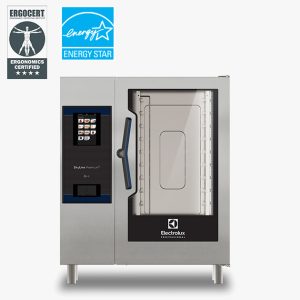
Stacked configurations increase output vertically, preserving floor space. Roll-in trolley systems enhance ergonomics in large-scale operations. Compact units support smaller restaurants or satellite kitchens.
Identifying the best commercial combi oven configuration requires aligning capacity with operational strategy rather than simply selecting the largest available model.
Installation, water quality and ventilation
Steam generation relies on water quality. Untreated water can lead to scale build-up, reducing efficiency and increasing maintenance frequency. Integrated filtration systems or external water treatment solutions protect internal components and preserve long-term performance.
Ventilation requirements vary depending on local regulations and cooking intensity. Many modern systems incorporate condensation management technologies that reduce vapour output and simplify installation.
Planning installation carefully ensures regulatory compliance, energy efficiency and reliable day-to-day operation.
Cleaning and maintenance routines
Regular cleaning safeguards both food quality and equipment longevity. Automated cleaning cycles reduce manual intervention and standardise hygiene procedures.
Effective systems typically include:
- Automatic detergent dosing
- Multi-stage wash programmes
- Water-efficient cleaning cycles
- Accessible components for inspection
Preventive maintenance, including gasket checks and probe calibration, supports consistent performance. Service agreements further reduce downtime risk.
Understanding what a combi oven is and how it integrates into professional kitchen workflows enables informed investment decisions. Discover the Electrolux Professional combi oven range and request expert guidance to identify the most suitable solution for your kitchen.
FAQs
What is a combi oven used for in professional kitchens?
It is used for roasting, steaming, baking, regenerating and slow cooking, often replacing multiple standalone appliances.
Why choose a commercial combi oven instead of separate equipment?
It centralises production, improves space utilisation and enhances consistency through controlled humidity and airflow.
What defines the best commercial combi oven?
Precise humidity control, programmable intelligence, energy efficiency and reliable after-sales support are essential criteria.
Is an Electrolux Professional combi oven suitable for high-volume operations?
Yes. Its engineering supports stable performance, repeatable results and scalable production across demanding service environments.