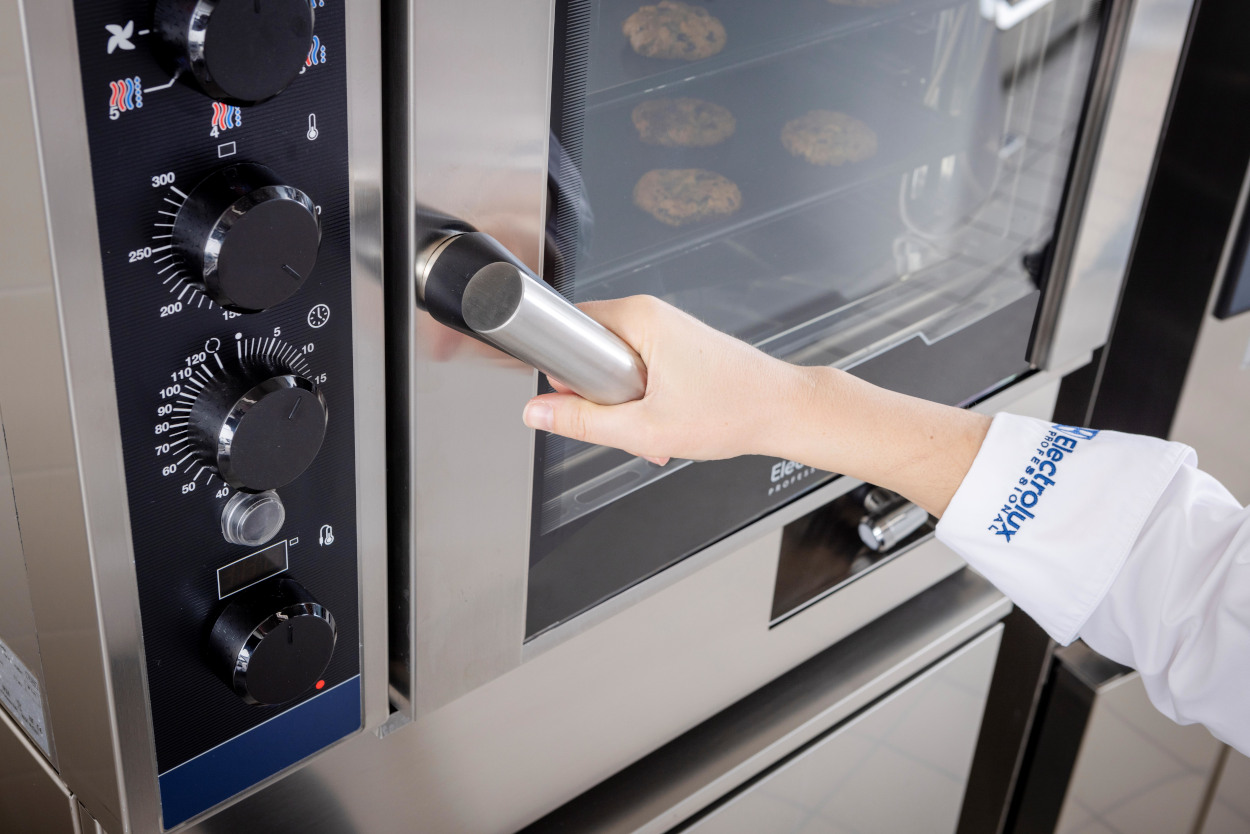
Two ovens set to the same temperature can produce noticeably different results, and the reason usually comes down to how heat actually moves inside the cavity. For a commercial kitchen deciding between a convection and a conventional oven, that difference isn’t academic: it affects cooking time, consistency across batches, and ultimately how the kitchen runs during service.
How heat moves differently in a convection oven and a conventional oven
A conventional oven relies on radiant heat from fixed elements, with air inside the cavity staying largely still. Heat transfers to food mainly through direct radiation and natural air movement, which tends to create hotter and cooler zones depending on position in the oven.
A convection oven adds a fan that actively circulates hot air around the cavity. This forced airflow strips away the thin layer of cooler air that naturally forms around food, transferring heat more quickly and more evenly across every rack position. It’s a mechanical difference with a very practical consequence: what cooks unevenly in a conventional oven often comes out consistent in a convection one.
Cooking speed and consistency: why convection wins on high-volume batches
For kitchens running multiple trays through service, convection is generally the stronger choice. The moving air cuts cooking times, commonly cited at around 25% faster than a conventional oven at the same set temperature, while producing more even browning across every position in the cavity rather than just the centre.
This matters most where consistency across a large batch is non-negotiable: roasting vegetables for a busy lunch service, baking multiple trays of the same item, or reheating for high covers. A kitchen that depends on repeatable results at volume tends to find a conventional oven simply can’t keep pace.
When a conventional oven is still the better choice: delicate bakes and simple menus
Convection isn’t the better option in every case. The same airflow that speeds up cooking and improves browning can also dry out or unevenly rise delicate items, such as certain sponges, soufflés or custards, where a still, gentle heat produces a more reliable result.
For a kitchen with a simple, low-volume menu, or one built around a small number of delicate bakes, a conventional oven can still be the more sensible choice: fewer variables to manage, and no need to adjust recipes for fan-assisted heat.
Energy efficiency: how faster cooking translates into lower running costs
Because a convection oven cooks faster and at more evenly distributed temperatures, it typically uses less energy per batch than a conventional oven doing the same job, even though it draws additional power to run the fan. Shorter cooking times mean the oven spends less time at temperature overall, which adds up meaningfully across a full day of service.
Electrolux Professional’s Crosswise convection ovens range is built around this kind of everyday reliability, offering precise temperature control alongside the load capacity kitchens need for consistent, high-volume cooking without unnecessary energy waste.
Convection oven or combi oven: avoiding a common buying mistake
One of the most common equipment mistakes in a commercial kitchen is buying a combi oven when a standard convection oven would do the job just as well, or the reverse: choosing a convection oven for a kitchen that actually needs steam-based cooking as part of its daily menu.
A combi oven adds a third capability on top of convection heat: precise steam injection, which allows a kitchen to move between dry heat, moist heat, and a combination of both without switching equipment. The SkyLine combi oven range, for instance, cuts idle energy consumption by roughly 10% when holding temperature without active cooking, and its Eco cleaning cycles can reduce running costs by up to 50% on water, detergent and energy combined. For a menu that regularly needs steaming, poaching or rethermalising alongside standard baking and roasting, that additional flexibility usually justifies the higher upfront cost. For a kitchen focused purely on baking, roasting and high-volume batch cooking, a dedicated convection oven remains the simpler and often more cost-effective choice.
Choosing between a convection oven, a conventional oven and a combi oven isn’t really about which is objectively better, but about which one actually matches the kitchen’s menu and production volume. Understanding how heat moves in each type is the starting point for making that choice with confidence, rather than discovering the limits partway through service.