
The pace of modern life rarely leaves room for reflection. We are constantly encouraged to replace, upgrade, and move on. But as sustainability moves from aspiration to necessity, the commercial laundry industry is beginning to ask a different question: Do we really need to start from scratch every time?
“As a society, we’ve been conditioned to think that newer automatically means better,” says Andrea Caputo, Customer Care and Sustainability Director at Electrolux Professional Group. “But when you look at the environmental impact of constant replacement, it becomes clear that we need a different model.”
Moving beyond the linear economy
For decades, manufacturing has followed a linear ‘take‑make‑waste’ approach, extracting raw materials, producing equipment, and discarding it at the end of its first life. While efficient in the short term, this model has contributed to rising consumption levels that now put pressure on natural resources, climate stability, and economic resilience.
“If left unchecked,” Caputo explains, “this approach risks pushing ecosystems beyond safe limits. That’s why simply continuing as before is no longer an option.”
Governments have begun to respond. In Europe, the Circular Economy Action Plan, part of the EU Green Deal, aims to decouple economic growth from resource use and support climate neutrality by 2050.
From linear to circular: the 7Rs
At the heart of the circular economy lies a fundamental shift in thinking, often expressed through the 7Rs: reduce, return, reuse, repair, redesign, recycle and remanufacture.
“These principles help reframe the entire lifecycle of a product,” says Caputo. “You start by reducing resource use, extending product life through repair and reuse, and ultimately bringing value back through remanufacturing.”
Among the 7Rs, remanufacturing stands out for its potential impact in professional laundry. Unlike repair or refurbishment, remanufacturing creates a product that meets current safety, performance and quality standards using recovered components.
“It’s not about giving a machine a quick fix,” Caputo adds. “It’s about giving it a new life.”
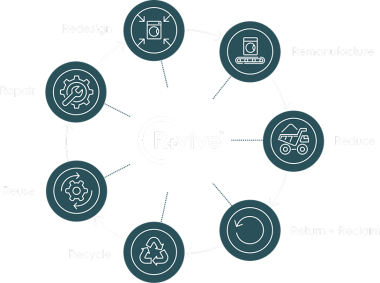
Introducing R+vive: circularity in action
Electrolux Professional has translated this thinking into reality with R+vive, its pioneering circularity project for commercial washing machines.
Thanks to a modular design approach introduced as early as 1999, machines from previous generations can now be remanufactured using recovered components. “Up to 65% of a machine’s total weight can be reused,” Caputo explains, “which dramatically reduces the need for new raw materials.”
R+vive machines are rebuilt to match the specifications of today’s Line 6000, available in 7–33 kg capacities, tested for 30,000 cycles, and covered by an Electrolux Professional warranty.
Early assessments show a Circular Transition Indicator score of 68%, more than double that of a new machine, while delivering up to 25% lower utility consumption. At the end of life, 95% of the machine can be recycled.
Closing the loop
To support remanufacturing at scale, Electrolux Professional has also introduced a pan‑European take‑back programme for Generation 3000, 4000 and 5000 washers.
“Circularity only works if products come back into the system,” Caputo concludes. “With R+vive, we’re not just extending machine life—we’re proving that circular manufacturing can work in the commercial laundry industry.”