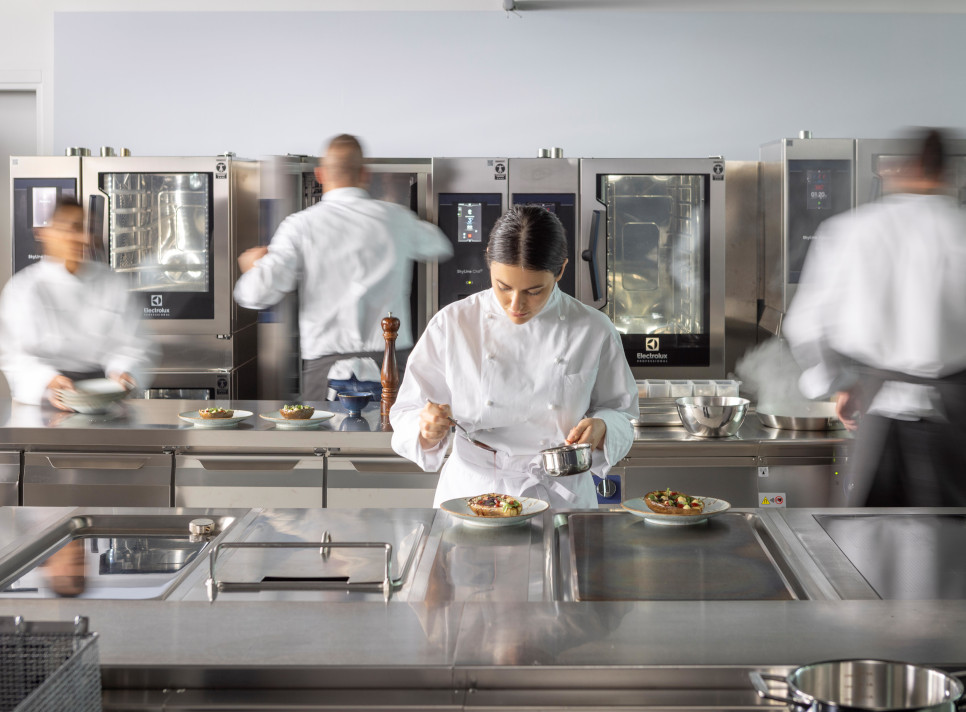
Designing a modular kitchen for a professional operation means building a back-of-house that can sustain output, support cleanliness and food safety, and staff movement, and adapt as covers, menus, or service formats change, while keeping equipment choices and installation constraints aligned from day one. A coherent modular cooking range and correctly specified modular kitchen units help scale capacity without forcing a full redesign every time the business evolves.
Why choose modular cooking for professional kitchens?
Modular cooking is a practical approach when the kitchen must stay flexible without becoming fragile. Instead of concentrating capability into a single fixed line, modularity distributes key functions into individual units that can be added, replaced, or rebalanced with less disruption.
In operational terms, a modular kitchen supports:
- predictable station ownership, because each module is built around a clear task;
- easier capacity growth, because output can be increased by adding or duplicating modules;
- simpler lifecycle decisions, because a single unit can be upgraded without changing the whole room;
- faster recovery from downtime, because one failure does not necessarily stop the full cooking battery.
The main trade-off is that modularity only works if workflows are planned first; otherwise, a kitchen becomes a collection of units rather than a system.
How to plan kitchen zones and workflows
Planning zones is less about drawing rectangles and more about deciding what must never cross. A robust modular design starts with flows, then converts flows into zones, then converts zones into unit selection.
Start by mapping these routes:
- product route from receiving to storage, prep, cooking, pass, and service;
- staff route between stations during peak service;
- cleaning and waste route that avoids food handling areas;
- heat and extraction route that matches the cooking load and keeps the room workable.
From there, define zones that reduce conflict:
- receiving and storage, with direct access and clear segregation;
- cold prep, positioned to stay stable and protected from the hot line;
- hot production, organised by the menu’s high-frequency items;
- pass and plating, treated as quality control and speed control;
- warewashing, sized to the peak and separated from food routes.
A useful check is to walk a peak-service ticket through the room: if the same metre of floor must carry hot plates, raw product, and waste bins, the layout is not finished.
Choosing modular kitchen units by station
Selecting modular kitchen units by station keeps specifications consistent and avoids “filling space” with equipment that does not carry its share of throughput. Each station should be designed as a complete micro-workflow with the right utilities, storage, and access.
Cooking line and modular ranges
Start with the menu mix and the peak hour, then decide which cooking methods drive the majority of tickets. The cooking line should be built around repeatability, not hero performance.
Selection criteria that usually matter most:
- sequence of operations, so that the station supports the natural order of cooking and finishing;
- ergonomics, so that the line can be operated safely across long shifts;
- cleaning access, because equipment that is easy to keep clean supports pace and consistency;
- serviceability, because poor access creates avoidable downtime.
A modular cooking range is most effective when the modules share consistent logic for controls, spacing, and access, so that staff do not need to “relearn” the line as they move between sections.
e-XP 700 & 900: product choices that support modular design
If the cooking line is being designed around a single platform, e-XP 700 & 900 Modular Cooking provides a useful reference point for modular specification: modules are available in two depths (700 mm and 900 mm) with installation options intended to fit different workflows and footprints.
From a station-planning perspective, it can help to think in module families rather than single appliances:
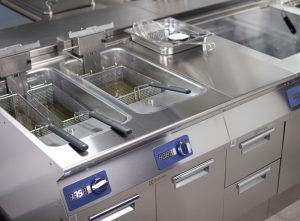
- Direct cooking modules for high-contact techniques, with robust, heat-efficient surfaces designed to avoid flavour transfer.
- In-well cooking solutions for multifunction prep and space optimisation where multiple cooking preparations must run in parallel.
- Indirect cooking modules (gas or electric) with precise temperature control and energy-saving logic.
If the menu or volume profile points to specific “pressure stations”, e-XP also groups innovation around common high-load use cases:
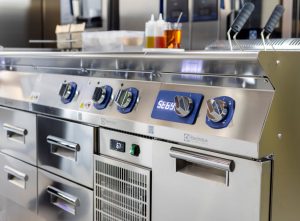
- e-XP Free-zone Induction: four independent cooking zones with four knobs and four digital displays for power and temperature control, positioned to combine flexibility with energy-saving operation.
- OptiOil FryersHP: Advanced Oil Filtration system (paper filters) designed to improve consistency and reduce oil use (Electrolux Professional reports up to 50% oil savings based on internal tests) and high output (published reference up to 66 kg of potatoes per hour in the cited test conditions).
- Auto-refill Pasta Cookers: automatic water refilling designed to keep the optimal water level, reduce downtime, and maintain consistent boiling performance for pasta, rice, vegetables, and other boil-driven production.
Refrigeration and cold prep
Cold prep is where quality control is won or lost, because poor positioning creates temperature drift and unnecessary movement. The simplest rule is to keep chilled storage close to the point of use and avoid designing a station that forces repeated door openings or long carrying routes.
Common design decisions include:
- whether raw handling and ready-to-serve prep require separate benches or separate zones;
- whether undercounter refrigeration is needed at specific stations to reduce trips;
- how labelling, storage rotation, and cleaning access will work in practice.
A cold prep zone that stays calm during service tends to produce better consistency than a cold prep zone that shares traffic with plating and hot returns.
Prep, plating and pass
Prep and pass stations should be sized for variability. During peak, plating is often limited by surfaces, reach, and handoff clarity rather than by cooking speed.
A scalable pass typically includes:
- dedicated space for finishing and garnishing;
- clear separation between “in progress” and “ready to run”;
- a defined route for runners that does not cut through the hot line;
- room for corrections, so that one issue does not block the full pass.
If the operation includes delivery or takeaway, the pass may need an additional packing step that is physically separate from plating.
Layout principles and example configurations
Modular kitchens scale best when the layout is based on rules that hold up across refurb cycles, menu changes, and staffing variations.
Practical principles:
- keep the hot core compact, so that the cooking line and pass stay close and time loss is reduced;
- protect prep, so that cold and clean zones are not used as shortcuts during service;
- design for access, so that cleaning and maintenance can happen without dismantling neighbouring units;
- plan utilities early, so that power, water, drainage, and extraction support the final equipment mix rather than restricting it.
Example configurations that frequently suit modular systems:
- line and pass, where the cooking line faces a dedicated pass and circulation is tightly controlled
- island suite, where access is improved but extraction and traffic management must be designed carefully
- galley layout, where two parallel runs create a natural separation between hot production and prep or plating
A configuration is only “right” if it supports the menu and the service model; copying a layout without copying the operating assumptions is a common source of performance gaps.
Maintenance and lifecycle planning
Modularity is a lifecycle advantage only if the kitchen is designed for maintenance from the start. The goal is not to avoid maintenance, but to make it predictable and low-disruption.
Lifecycle planning should cover:
- access routes for service engineers and replacement parts;
- safe isolation points for utilities;
- daily cleaning routines that keep the line clean without moving heavy units;
- redundancy for critical tasks where downtime would stop service.
Standardising module types also helps, because training, spares, and fault diagnosis become simpler across shifts and, if relevant, across sites.
Common pitfalls to avoid
Most failures in modular projects are design logic issues rather than equipment issues.
- Designing around averages: peak hour and ticket mix should drive station sizing and module selection.
- Ignoring support capacity: warewashing, cold storage, and prep surfaces can bottleneck a strong cooking line.
- Under-planning extraction and comfort: a hot line that is hard to work on will reduce output and consistency.
- Blocking access: tight installations make deep cleaning and maintenance slower and more frequent.
- Over-customising early: overly bespoke layouts reduce flexibility and increase the cost of change.
If you are planning a new build or refurb and want to translate zoning, workflows, and station sizing into a practical specification, explore Electrolux Professional solutions for modular kitchen units and modular cooking range configurations, and speak with a specialist to align the design to your service model and site constraints.
FAQs
What is a modular kitchen in a professional setting?
A modular kitchen is a commercial kitchen designed around individual, standardised units organised by station, so the layout can be expanded or rebalanced without rebuilding the entire back-of-house.
How do you size modular kitchen units for peak service?
Start with the peak hour, then translate the menu mix into station loads, holding needs, and handoff points. Units should be selected to support the station’s full workflow, not just the primary appliance.
What should be decided before choosing a modular cooking range?
Zoning and movement rules should be fixed first, including product routes, staff routes, waste routes, and the relationship between prep, hot production, and pass. Once these are clear, the modular cooking range can be configured to match real throughput constraints.
Which layout is best for a small commercial kitchen?
Space-constrained kitchens often perform best with a disciplined galley or compact line-and-pass approach, provided that crossing routes are avoided and prep is protected from the hot line.
How can modular design reduce downtime?
Downtime reduces when modules have proper service access, utilities can be isolated safely, cleaning is straightforward, and critical tasks have redundancy or an alternative workflow during maintenance.