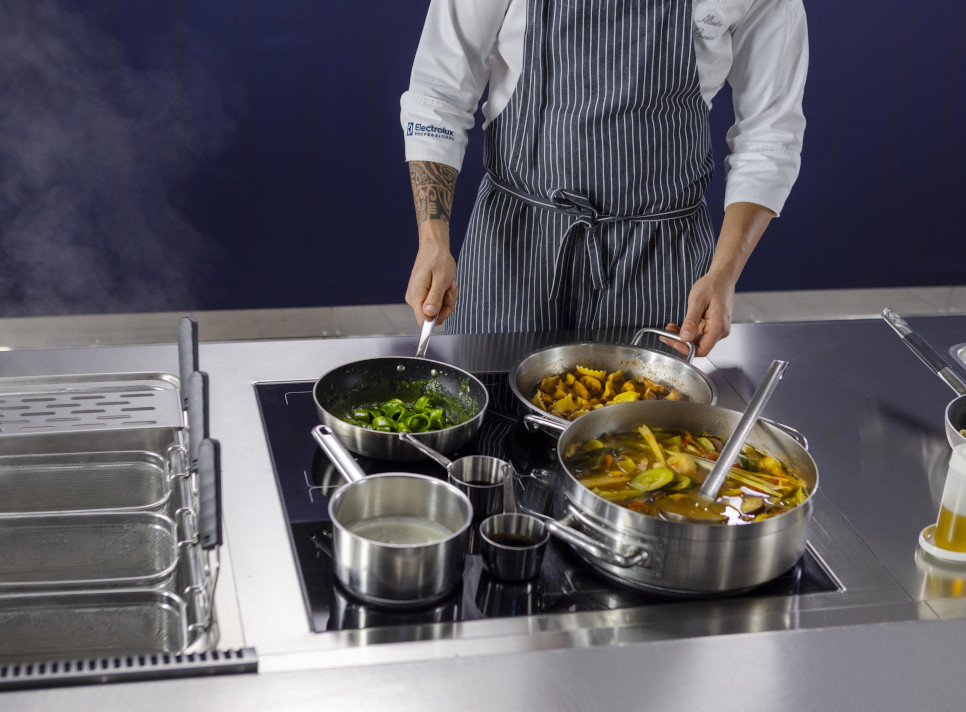
Choosing between a gas or induction hob is less about preference and more about matching cooking method to service pressure, infrastructure, and the realities of running a professional kitchen day after day. A commercial gas hob can deliver familiar flame control and strong heat transfer in certain pan techniques, while a commercial induction hob can offer rapid responsiveness, lower ambient heat, and a more controlled working environment.
This guide compares induction or gas hob options through the factors that typically determine performance and cost in commercial use, including gas or induction hob running costs, ventilation load, safety, and specification priorities.
How do gas and induction hobs work?
A gas hob generates heat by burning gas and transferring energy via the flame to the pan and surrounding air. That means part of the energy goes into the cookware, and part becomes ambient heat in the kitchen.
Induction works differently. The hob creates an electromagnetic field that induces heat directly in compatible cookware, heating the pan rather than the surrounding air. In practice, that usually translates into less wasted heat and more targeted energy delivery, although results depend on the cookware base, pan size relative to the zone, and how consistently the station is used.
A practical implication for design is that gas tends to behave like a “room heating” source as well as a cooking source, while induction tends to be more “pan focused”. This distinction shows up later in comfort, ventilation strategy, and running costs.
Heat control, responsiveness and speed
Both technologies can be precise, but they are precise in different ways.
Gas is intuitive for many chefs because the flame is visible and continuous, and manual adjustments feel immediate. It also supports techniques where flame interaction matters, such as certain wok methods on appropriate equipment, or rapid pan movement where the chef wants a constant heat source regardless of pan position.
Induction is typically strong on repeatability. Power can be set and replicated across shifts, and pan response can be fast because energy is delivered directly to the cookware. In high-pressure service, that can help standardise results across multiple operators.
Speed is not only about “boil time”. In real kitchens, speed also includes how quickly a station recovers after adding cold product, how predictable heat is during high-frequency cooking, and how often the chef must compensate. Induction often performs well in recovery and control when cookware is correctly matched. Gas often performs well when the cooking style relies on continuous heat across varied pan movements.
If your priority is consistency across a team, induction can support more standardised output. If your priority is versatility across pan techniques and tactile control, gas can still be the better fit in some stations.
Platform example: e-XP Free-zone Induction
If the priority is repeatable, fine-grained control across shifts, the Electrolux Professional e-XP Free-zone Induction is designed around four independent cooking zones with four knobs and four digital displays, enabling control by temperature or power depending on the task.
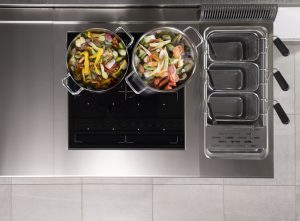
It also supports set-point style working (temperature control) rather than relying purely on chef intuition, which can help standardise outcomes in high-frequency service where multiple operators share the same station.
Ventilation, ambient heat and comfort
This is where the technologies diverge most in day-to-day experience.
- Gas produces combustion products and more ambient heat. That generally increases the load on the kitchen environment and can make comfort harder to maintain in compact or high-output spaces. It can also influence how the brigade moves and how long staff can stay effective at the line during peaks.
- Induction typically reduces radiant heat and can contribute to a cooler working environment. That can matter for staff comfort, but it can also matter for operational rhythm, because fatigue and heat stress tend to rise quickly in hot lines during busy services.
- Ventilation decisions should always be made with qualified designers and aligned to legislative requirements, but from a practical perspective the choice of hob affects not just extraction sizing, but how tolerable the line is over long shifts, especially in kitchens where heat management is already a constraint.
Infrastructure and cookware compatibility
The best-performing hob is the one your building can support reliably.
Gas infrastructure considerations include supply availability, pipe sizing, shut-off and safety systems, and the practicalities of installation in refurb projects. The operational side includes checks, servicing, and the responsibilities that come with any gas appliance in a commercial workplace.
Induction infrastructure is primarily electrical. You may need higher electrical capacity, suitable phases, and an approach to demand management if multiple high-load appliances run concurrently. Regarding the latter, Electrolux Professional foodservice appliances are certified as compatible with Sicotronic, who offer an intelligent load management solution ensuring appliances receive the power they need – while avoiding energy peaks that can strain the system or drive up bills. In addition you can track and analyse individual appliance performance with this insight allowing them to recommend smarter usage schedules and eliminate unnecessary energy consumption.
Cookware compatibility is also decisive:
- Gas works with most cookware, assuming it is stable and sized appropriately for the burner.
- Induction requires induction-compatible cookware, usually with a ferromagnetic base, and performs best when pan diameter matches the zone and the base is flat and in good condition.
When teams evaluate the best commercial induction hob, they often focus on headline power, but cookware strategy is equally important. If the kitchen needs a full cookware refresh to make induction work, that cost should be acknowledged in the transition plan.
When to choose gas vs induction
There is no universal answer to “gas vs induction”. The right choice is often station specific, and many kitchens run mixed lines for good reasons.
High-output à la carte service
À la carte service is defined by fast cycles, constant adjustments, and variable pan work. Induction can be strong here when the priority is rapid response, repeatability, and a more comfortable line, particularly where stations are tightly packed and heat load is already high.
Gas can still suit à la carte stations where pan movement, flame interaction, or chef preference drives performance, and where the team relies on flame cues for technique. The decision often comes down to whether the station is built around controlled, repeatable output or around tactile flexibility.
A useful approach is to assign induction to stations where precision and speed dominate, and gas to stations where flame-based technique is central, provided infrastructure and safety responsibilities are aligned.
Banqueting and production kitchens
Production environments tend to reward predictability and energy control, especially when multiple items are being prepared in parallel and the goal is consistent batch outcomes. Induction can support that control and can help manage ambient heat in large-volume output.
Gas can remain relevant for specific high-volume tasks and cookware types, but production kitchens typically benefit from designing around repeatable parameters and workload distribution, which often aligns well with induction.
For gas or induction hob running costs, production sites should look beyond unit energy use and include knock-on costs such as comfort management, extraction demand, and the impact of heat on pace, because these secondary factors can become material over long operating hours.
Teaching and training environments
Training kitchens have a different risk profile and learning objective. Gas supports teaching foundational flame-based technique and gives immediate visual feedback, which can be valuable for skill building.
Induction can be attractive where safety, control, and ease of supervision are priorities, particularly when the training space hosts frequent student rotation and the operator wants more standardised outcomes with less environmental heat.
In many training contexts, mixed stations are a practical compromise, using gas where technique must be taught and induction where consistency and safety take priority.
Specification checklist
Use this checklist to compare a commercial gas hob and commercial induction hob specification against your actual service model:
- Menu and technique: define which dishes rely on flame interaction, and which rely on precise temperature control.
- Peak workload: quantify peak covers, ticket mix, and the number of pans in use simultaneously at each station.
- Infrastructure readiness: confirm gas availability and safety requirements, or electrical capacity and demand management constraints.
- Cookware strategy: confirm induction compatibility, pan sizes, base condition, and replacement plan if needed.
- Line comfort: evaluate ambient heat tolerance, staff rotation, and confirmed constraints in the space.
- Cleaning and upkeep: compare daily cleaning time, service access, and planned maintenance expectations.
- Operating costs model: estimate gas or induction hob running costs using your local tariffs, usage hours, and any secondary impacts such as comfort management and productivity loss in high-heat conditions.
- Future flexibility: consider whether the site may shift menus, volumes, or energy strategy over the next five to ten years.
FAQs
How do I decide between a gas or induction hob for a professional kitchen?
Start with cooking method and workload, then validate infrastructure and cookware constraints. The choice is often station specific rather than kitchen wide.
Which is faster, induction or gas hob?
Speed depends on cookware, station setup, and the cooking pattern. Induction is often strong in responsiveness and recovery with compatible pans, while gas can be strong for techniques relying on constant flame and pan movement.
Which has lower running costs, gas or induction?
Gas or induction hob running costs depend on local tariffs, operating hours, and efficiency in your real usage pattern. A practical cost comparison should include secondary impacts such as ambient heat management, cleaning time, and any cookware transition costs.
Do I need special pans for a commercial induction hob?
Yes. A commercial induction hob requires induction-compatible cookware, typically with a ferromagnetic base. Performance improves when pan diameter matches the induction zone and bases are flat and in good condition.
Is a mixed line sensible for many kitchens?
Yes. Many kitchens use induction where precision, speed, and comfort are priorities, and gas where flame technique and pan versatility are central, provided infrastructure and maintenance responsibilities are clear.